
 The push for news departments to turn a profit has cut resources for foreign coverage, reduced the number of foreign bureaus, limited on-the-ground reporting, and consolidated news sources. Watch news shows or check online, and you’ll notice that everyone reports the same information from the same few outlets: “The AP reports…” or “UPI is reporting…”
Where did independent investigative reporting go? Research now often means sitting at a computer, reviewing what the few remaining large news organizations are already reporting. A few outlets still do solid, boots-on-the-ground reporting—we’re not complete media cynics, just mostly.
Lack of investment in reporting cited
The lack of investment in reporting has also encouraged busywork inside newsrooms to create the illusion of diverse sources. Increasingly, stories get elevated and labeled as “breaking news” to add drama, excitement, and urgency. Cable news’s overuse of the term “breaking news” now misses the mark more than an umpire with glasses misses a strike. The result has become comic. Here’s how “hard-hitting news” plays out on an actual broadcast:
 Anchor1 (Steve) (a dashing man who looks like he spends too much time in makeup): “Now, this breaking news!” His tone suggests the next words might report the death of your dearest Aunt Mable. “The Times reports that this year’s corn cobs have more kernels, and researchers and industry experts have begun debating why. For more on this breaking news, let’s go to Kendra.” She stands five feet away from the anchor, in front of a screen showing a man driving a tractor down a cornfield.
Kendra (cute, blonde, double-dimpled, seemingly straight out of a hair commercial): “Well, Steve, we’re just learning the details of this breaking story. This discovery was actually made in the cornfield by a corn farmer, who noticed the cobs appeared longer this year. For a deeper look, let’s go to Mike, who actually talked to the farmer in person.”
Viewers on their seats watching Kendra’s reporting.
Viewers may find themselves leaning forward in anticipation—even as Kendra stands inside. Some secretly hope a gust of wind will sweep her  perfectly styled hair across her face, prompting that little pout she makes when reporting human-interest stories—or puppies saved from euthanasia. “Mike, what did you find in your exclusive, hard-hitting reporting on K-Diddle-Diddle-Y News?”
The camera shifts to Mike, standing five feet from Kendra, in front of another screen projecting a close-up of the farmer, wearing a seed-corn hat and looking in desperate need of a shave. The setup makes it appear that Mike is talking directly to him.
Mike (whom we don’t know what is going on with his hair; we’re not sure he even washes or combs it): “Yes, Kendra, I was able to get the corn farmer on the phone tonight. It was exciting to bring this to our viewers. He had stopped picking the corn in the field to get a bite to eat, and we were able to get him on the phone. The farmer said that he noticed the corn cobs are a bit longer this year. Let’s give a listen…”
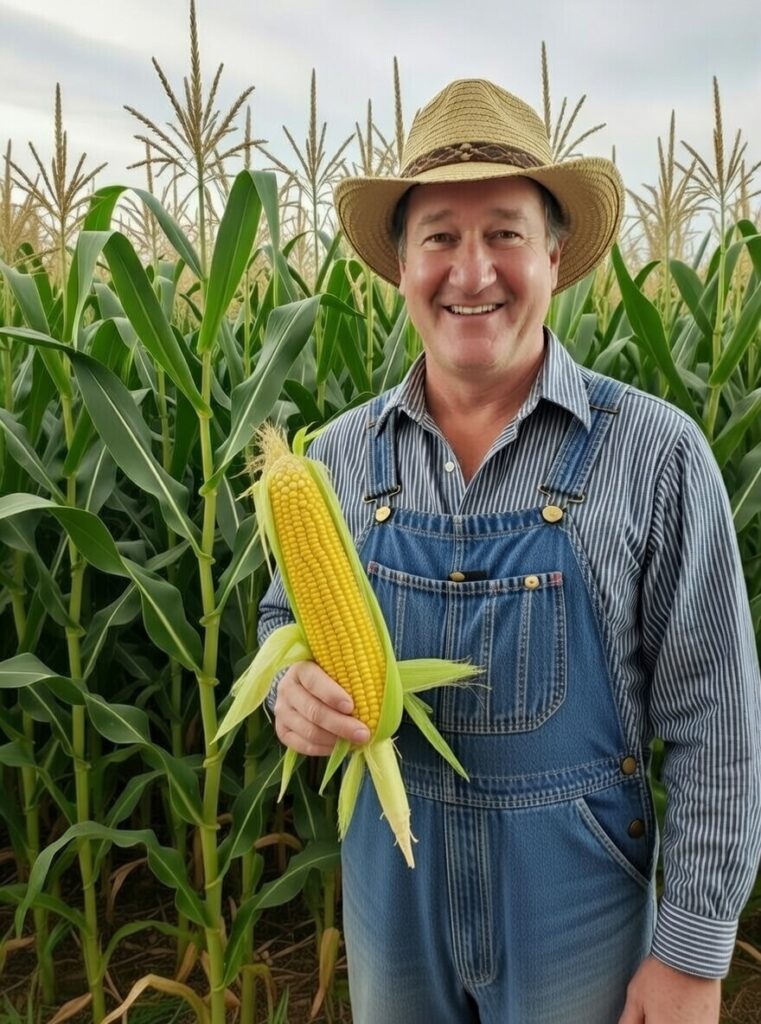
Farmer appears happy with the corn crop
The screen is now filled with a still of the farmer.
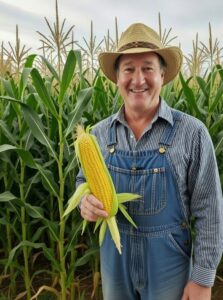 We hear the farmer’s poorly edited voice clip: “I noticed the corn cobs were a bit longer this year… And I don’t like flavored popcorn…”
The camera has now turned back on Mike.
Mike: “There you have it, Kendra. An exciting story and the big question now? WHAT is going on (emphasis on “what”)? Back to you, Kendra.”
We now get a close-up of Kendra: “Wow. Thanks, Mike. To cover this story from all angles, I contacted a local seed corn company. They mentioned a possible discrepancy in how the kernels are being counted. We also reached out to another seed corn company, but they didn’t respond, so we may need to dig even deeper into this story. Some wild stuff is happening in our local cornfields, Steve.”
Kendra pauses for a moment, realizing how silly that sounded. “Back to you, Steve.”
Anchor 1 (Steve) tilts his head slightly to the right, letting viewers absorb what they’ve just seen and heard.
“We’ll keep on top of this story for our viewers. When we return, we’ll show you how a local food company is changing labels you may already recognize.”
News segments are little more than lead-ins for commercials
Of course, this segment mostly serves as a commercial for the local food company—but it does include live video. Wahoo! “Now let’s take a break.”
Here, “break” really means a commercial. After being on air for three to five minutes, the anchors could probably continue for another two or three—but that corn cob story was exhausting. Maybe they really do need a break… to touch up their hair and makeup.
Watch a local news broadcast one night, and you’ll notice that top stories typically get two to five minutes of coverage. Whether there are two or twelve top stories, each receives roughly the same amount of time.
After the brief coverage of real news, the template kicks in. The anchors tease upcoming stories and remind viewers to stay tuned. Sometimes they even run “news commercials”—promotions for stories later in the broadcast—and tell us to tune in at ten o’clock. Ten o’clock! Some viewers protest: “I want to know about the disappearing Painted Shetland Ponies NOW!”
When viewers finally stay up for the ten o’clock story, they often find that the preview took almost as long as the story itself. And for the record, the Painted Shetland Ponies weren’t disappearing; the farm they were on was being sold, the ponies moved to another farm in another state, and a new car dealership—the segment’s sponsor—was taking over the land.
Anchor 1(Steve) is fired!
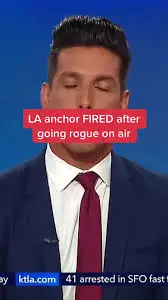 News Flash! Anchor 1(Steve) has been fired for going rogue on air. What would Walter Cronkite say?